Where to Upload Your Resume for Skilled Trade Jobs
For decades, skilled trade workers were told where to upload your resume didn’t matter — just “upload your resume online, apply everywhere, and hope someone calls back.” That doesn’t work anymore. Indeed, if you’re an electrician, welder, HVAC tech, diesel mechanic, carpenter, plumber, machinist, heavy equipment operator, or work in any skilled trade, simply uploading…
For decades, skilled trade workers were told where to upload your resume didn’t matter — just “upload your resume online, apply everywhere, and hope someone calls back.”
That doesn’t work anymore.
Indeed, if you’re an electrician, welder, HVAC tech, diesel mechanic, carpenter, plumber, machinist, heavy equipment operator, or work in any skilled trade, simply uploading a resume won’t get you the pay and opportunities you deserve.
As a result, Ultimately, most job seekers never learn where to upload your resume, so the right employers actually see it — and that’s why they get overlooked.
Specifically, this guide shows you where to upload your resume, why job boards are failing tradespeople, and how digital portfolios are helping thousands of workers land better-paying jobs across the U.S.
Where to Upload Your Resume for the Best Results
However, your resume gets you access to job postings — but it doesn’t show employers what you can actually do.
Specifically, a resume cannot show:
- The quality of your work
- Tools you own
- Your certifications
- Your transportation
- Your professionalism
- Your required wage
- How far you’ll travel
- Hands-on experience
Clearly, in skilled trades, employers need proof, not promises.
:Instead, the real game-changer isn’t your resume placement strategy — it’s how you present yourself.
Additionally, to understand national apprenticeship requirements, you can visit the U.S. Department of Labor’s official apprenticeship resource:
Why Knowing Where to Upload Your Resume Matters in the Skilled Trades
Most skilled trade workers upload their resume to the wrong places, and it often cost them the pay, opportunities, and visibility.
The Trade Scouts Portfolio Advantage
First, uploading your resume to job boards is step one.
Second, building a digital portfolio on tradescouts.com is what gets you discovered, respected, and hired.
1. Portfolio Integration
Essentially, your Trade Scouts portfolio gives employers visual, verified proof of your skills — something no resume can do.
Your portfolio includes:
- First, photos of completed jobs
- Second, videos of work in progress
- Third, tools you own
- Fourth, certifications and licenses
- Fifth, transportation
- Sixth, employer recommendations
- Finally, Introduction video
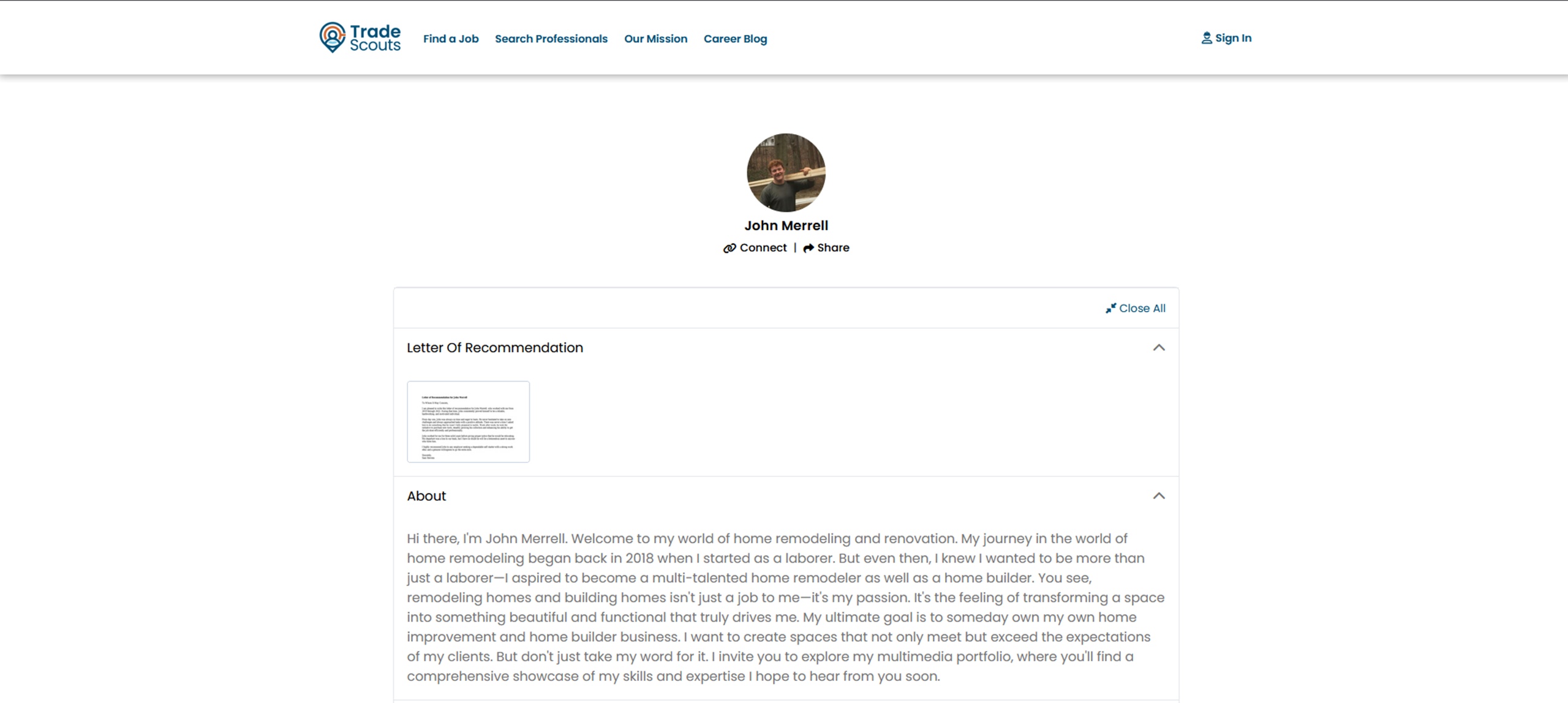
See a real example: John’s Trade Scouts Portfolio
2. Showcase Your True Value
In contrast, a portfolio shows your value.
With tradescouts.com, you can:
- First, upload work photos and videos
- Second, prove your skill level
- Third, show specialized tools
- Fourth, display certifications
- Fifth, set your wage and benefits
- Finally, specify travel distance
Consequently, this eliminates low-pay offers and wasted interviews.
3. Employers Apply to YOU
Traditionally, most platforms make you chase jobs.
However, Trade Scouts reverses it.
For example, you currently make $75,000, travel 35 miles, get partial insurance, and two weeks of vacation.
Next, set your portfolio requirements:
- First, minimum $85,000
- Second, full insurance
- Third, company truck
- Fourth, 20-mile commute max
- Finally, three weeks vacation
As a result, now only employers who meet your standards reach out.
Instead, you’re not chasing jobs — employers compete for you.
4. Professional-Only Environment
Typically, social media mixes your work with personal posts and unrelated content.
In contrast, Trade Scouts is different.
Specifically, it’s built only for skilled trade professionalism.
Watch how to create your portfolio:
What Skilled Trade Workers Really Want
Ultimately, when tradespeople ask “where should I upload my resume?”, they’re not just looking for a job.
Instead, they want:
- First, higher pay
- Second, steady work
- Third, respect
- Fourth, better opportunities
- Fifth, jobs matching their skill level
- Sixth, control
- Finally, recognition of their value
For decades, trades were undervalued; however, that’s changing fast.
Why Skilled Trades Are Now AI-Proof Careers
Currently, AI is replacing white-collar jobs, not skilled trades.
AI can’t:
- Install HVAC systems
- Repair heavy machinery
- Weld structural beams
- Diagnose diesel engines
- Rewire buildings
As a result, skilled trades are AI-proof careers, and workers now have more leverage than ever.
You can explore official job-outlook and wage data in the U.S. Bureau of Labor Statistics Occupational Outlook Handbook:
Consequently, Trade Scouts helps workers take full advantage.
The Biggest Mistake Job Seekers Make
Actually, the mistake isn’t uploading your resume.
Rather, the mistake is only uploading your resume.
Essentially, a resume is a list — not marketing.
As a result, companies advertise 24/7 because visibility creates opportunity.
Therefore, tradespeople need to do the same.
In the same way, a portfolio advertises your value 24/7 — even while you sleep.
Why Resumes Fail For Employers and Job Seekers
After 40 years as an employer, here’s the fundamental truth:
1. Employers Can’t See Your Work From Text Alone
For example, a resume might say “installed electrical panels.”
Nevertheless, employers still need to know:
- First, commercial or residential?
- Second, was it done safely?
- Third, was it inspected?
- Fourth, what was the quality?
- Finally, what tools were used?
In contrast, portfolios answer all of that instantly.
2. Mismatches Waste Time and Money
- For instance, a high-end framing carpenter shouldn’t be offered a $25/hr panel job.
- Similarly, a diesel diagnostics tech shouldn’t interview for oil changes.
For this reason, portfolios eliminate mismatches before they happen
What Employers Really Want to See
Ultimately, across all trades, employers want:
- Tools
- Certifications
- Transportation
- Work photos
- Videos
- Reliability
- Professionalism
- Communication skills
- Wage requirements
In addition, Fortunately, Trade Scouts provides all of this before the interview — saving everyone time.
What Tradespeople Experience on Traditional Job Boards
Typically, most workers face:
- First, no responses
- Second, low-pay offers
- Third, irrelevant listings
- Fourth, ATS keyword filtering
- Fifth, being overlooked for not being “good writers”
- Finally, employers wasting their time
Conversely, Trade Scouts eliminates the guessing game and puts workers in control.
Where Should You Upload Your Resume? The Real Answer
Simply put, if you want a job: upload your resume anywhere.
However, if you want the right job: upload your resume and build a Trade Scouts portfolio.
On one hand, your resume helps you apply.
On the other hand, your portfolio helps employers apply to you.
Ultimately, that’s the difference.
What to Upload First to Stand Out Fast
First, upload your introductory video first.
Specifically, it instantly shows:
- Communication skills
- Professionalism
- Confidence
Next, upload:
- Tools
- Work photos
- Certifications
- Transportation
Additionally, every item strengthens your value.
Real Results: Barry and John
Barry Adams
- Initially wanted to work for McDean in Washington, DC
- However, never got hired using traditional resumes
- Subsequently, built his Trade Scouts portfolio in 2020
- In fact, he is still working there in 2025.
John
- Built his portfolio right out of high school in 2021
- Furthermore, he is still receiving job offers today.
Clearly, Trade Scouts isn’t about bragging — it’s about helping workers build better lives.
For example, SkillsUSA helps young people enter the trades with hands-on training that pairs perfectly with a digital portfolio.
Final Answer: Where to Upload Your Resume
Therefore, stop thinking like a job seeker.
Instead, start thinking like a business.
In fact, you’re not just a worker — you’re a skilled professional with valuable expertise employers need. Essentially, you’re not just a worker — you’re a skilled professional with valuable expertise employers need.
Unfortunately, for too long, tradespeople were told to blend in, apply everywhere, and hope to get noticed.
Even so, that outdated approach might get you a job — but not the job you deserve.
Currently, we live in a visual, digital world where visibility equals value.
A resume is a relic. In contrast, a portfolio is your future.
Indeed, a portfolio is your future.
For example, when you build your portfolio on tradescouts.com, you create a living showcase of who you are, what you can do, and what you’re worth.
Thus, you take control of your career — so employers compete for you..
Therefore, if you’re ready for:
- Better pay
- Better opportunities
- Better quality of life
So, stop asking “where should I upload my resume?” Instead, Instead, start asking “how do I showcase my value?
The answer is waiting at: